Milky Way
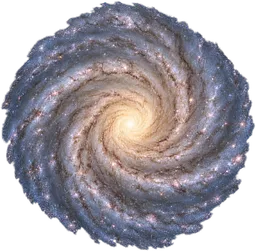
The Milky Way is a spiral galaxy containing hundreds of billions of stars, including our Solar System.
30.66 kpcDiameterWorlds apart
What are they, and what does the difference actually look like?
Two things. One honest scale.
Meet the pair
The Milky Way is a spiral galaxy containing hundreds of billions of stars, including our Solar System.
30.66 kpcDiameter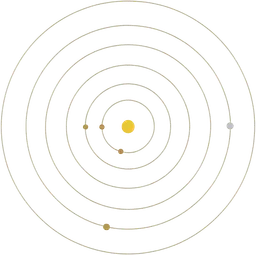
The Solar System is the collection of the Sun and all objects gravitationally bound to it, including planets, moons, and smaller bodies.
60.22 AUDiameterMilky Way has about 105,000,000 times the diameter of Planetary Solar System.
A rounded 100,000 light-year span of the stellar disk. Faint stars and the dark-matter halo extend farther; galaxies have no crisp rim.
The marked diameter is calibrated. Unmeasured illustration details are representative.
A schematic diameter spanning Neptune’s orbit. The Solar System also includes much more distant bodies. The illustration is a boundary diagram; dots identify objects or regions and do not depict their physical diameters.
Defined examples — our methodology
The marked diameter is calibrated. Unmeasured illustration details are representative.
Change the comparison
Measurement details
The visual compares diameter with diameter. The records below preserve each value’s basis and caveats.
Diameter · approximate
A rounded 100,000 light-year span of the stellar disk. Faint stars and the dark-matter halo extend farther; galaxies have no crisp rim.
Diameter · rounded reference
A schematic diameter spanning Neptune’s orbit. The Solar System also includes much more distant bodies. The illustration is a boundary diagram; dots identify objects or regions and do not depict their physical diameters.
The labelled spans and stored measurements determine the scale; unmeasured illustration details do not.
There’s always another scale
SpaceMilky Way30.66 kpcThe Milky Way is a spiral galaxy containing hundreds of billions of stars, including our Solar System.SpacePlanetary Solar System60.22 AUThe Solar System is the collection of the Sun and all objects gravitationally bound to it, including planets, moons, and smaller bodies.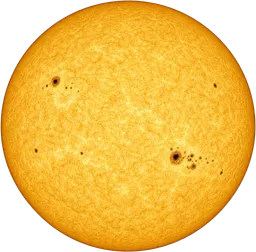 SpaceSun1,391,000 kmThe Sun is the star at the centre of the Solar System.
 SpaceDistance to the galactic centre7.972 kpcThis is the distance from the Solar System to the centre of the Milky Way galaxy.SpaceAndromeda galaxy79.72 kpcThe Andromeda galaxy, also called M31, is the nearest large spiral galaxy to the Milky Way.
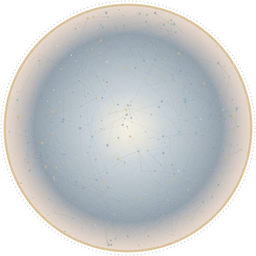 SpaceObservable universe28.21 GpcThe observable universe is the region from which light or other signals have had time to reach us since the early universe.SpaceEarth–Sun distance1 AUThe Earth–Sun distance, or astronomical unit, is the standard measure of separation between Earth and the Sun used in astronomy.
Side by side