Andromeda galaxy
The Andromeda galaxy, also called M31, is the nearest large spiral galaxy to the Milky Way.
Also known as: m31
How big is it?
79.72 kpc across
Diameter · approximate
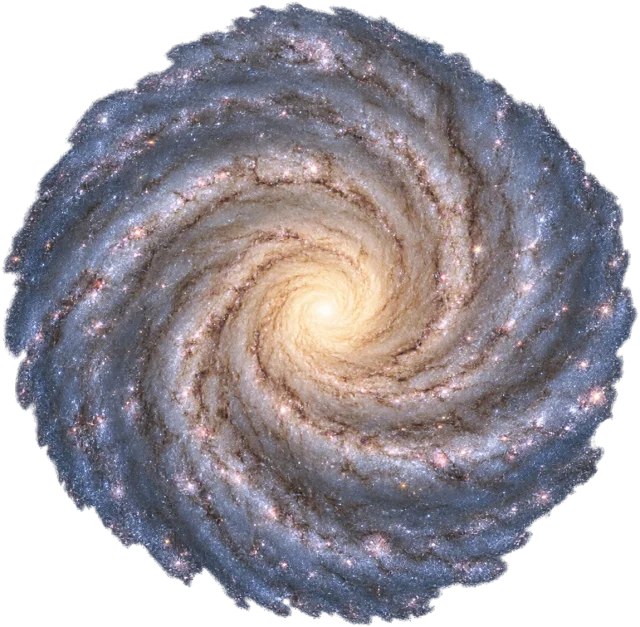
A little perspective
About 2.6 times the diameter of Milky Way.
Milky Way: The Milky Way is a spiral galaxy containing hundreds of billions of stars, including our Solar System.
Measurements, assumptions & sources +
Andromeda galaxy
The 260,000 light-year extent is NASA’s ultraviolet-view reference. Diameters measured with another wavelength or brightness threshold differ.
The marked diameter is calibrated. Unmeasured illustration details are representative.
Milky Way
A rounded 100,000 light-year span of the stellar disk. Faint stars and the dark-matter halo extend farther; galaxies have no crisp rim.
The marked diameter is calibrated. Unmeasured illustration details are representative.
Change your perspective
Put it next to…
Choose a suggestion to redraw the comparison, or open its page to learn what it is.
Why this measurement?
Why we use 79.72 kpc
For comparison, this page uses diameter. This is labelled approximate; the central value is useful for comparison, while real values or measurement solutions can vary.
The 260,000 light-year extent is NASA’s ultraviolet-view reference. Diameters measured with another wavelength or brightness threshold differ.
The marked horizontal span follows the named feature; transparent margins and unmeasured details do not alter it. How calibrated comparisons work →
Recorded properties
Andromeda galaxy dimensions and measurements
| Property | Selected value | Recorded range | Basis |
|---|---|---|---|
| 79.72 kpc | Not recorded | approximate | |
| 766.5 kpc | Not recorded | approximate |
Around this scale
Go smaller. Go bigger.
These links use compatible length records, ordered around the selected value.
 Nearest lower value · SpaceMilky Way30.66 kpcThe Milky Way is a spiral galaxy containing hundreds of billions of stars, including our Solar System.
 Nearest higher value · SpaceDistance to Andromeda766.5 kpcThis is the distance between the Milky Way and the Andromeda galaxy, our nearest large galactic neighbour.
Sources and method
Want to check the number?
The source records and measurement method remain available for inspection.
- NASA — The galaxy next doorDistance about 2.5 million ly; UV extent about 260,000 ly. A galaxy boundary depends on the observing method.
More ways to see it
Curated comparisons
There’s always another scale
Follow your curiosity.
SpaceMilky Way30.66 kpcThe Milky Way is a spiral galaxy containing hundreds of billions of stars, including our Solar System.SpaceDistance to Andromeda766.5 kpcThis is the distance between the Milky Way and the Andromeda galaxy, our nearest large galactic neighbour.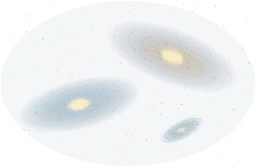 SpaceLocal Group3.066 MpcThe Local Group is a collection of galaxies that includes the Milky Way, Andromeda, and several smaller galaxies.SpaceDistance to the galactic centre7.972 kpcThis is the distance from the Solar System to the centre of the Milky Way galaxy.
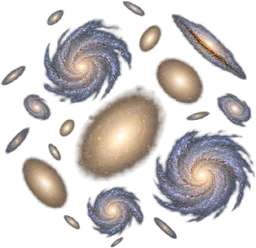 SpaceDistance to the Virgo Cluster16.56 MpcThis is the distance from the Milky Way to the Virgo Cluster, a nearby large cluster of galaxies.
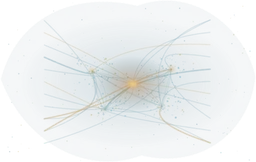 SpaceLaniakea-scale region159.4 MpcLaniakea is a vast region of interconnected galaxy clusters defined by shared gravitational flows.SpaceDistance to Sirius8.6 lyThis is the distance from the Sun to Sirius, the brightest star in the night sky.SpaceDistance to Proxima Centauri4.25 lyThis is the distance from the Sun to Proxima Centauri, the closest known star to our Solar System.