
Sea star tube-foot travel
Sea star tube-foot travel is the movement speed of a sea star as it uses its tube feet to glide over surfaces.
How big is it?
0.0003 m/s · travel speed
Travel speed · representative
Typical recorded range: 5 × 10⁻⁵ m/s to 0.001 m/s.
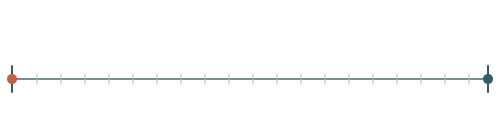
A little perspective
Sea star tube-foot travel vs Electron drift in household copper wiring: speed comparison
The speed of a sea star’s tube-foot travel is about 3 times electron drift in household copper wiring.
DISTANCE IN ONE SECOND
Sea star tube-foot travel is the movement speed of a sea star as it uses its tube feet to glide over surfaces.
300 µm in 1 s
This refers to the slow average movement of electrons through copper wire when an electric current flows.
100 µm in 1 s
Measurements, assumptions & sources +
Sea star tube-foot travel
Travel speed: 0.0003 m/s; representative; range 5 × 10⁻⁵ m/s–0.001 m/s.
A representative 0.3 mm/s travel speed for a sea star using coordinated tube feet. Species, size, substrate, water conditions and motivation change the pace.
Defined examples — our methodology
The marked travel speed is calibrated. Unmeasured illustration details are representative.
Electron drift in household copper wiring
Representative charge-carrier drift speed: 0.0001 m/s; representative model; range 1 × 10⁻⁶ m/s–0.01 m/s.
A representative 0.1 mm/s electron drift speed in a current-carrying household copper conductor. Wire area, current and carrier density change the value; the electrical signal propagates far faster.
Defined examples — our methodology
The marked representative charge-carrier drift speed is calibrated. Unmeasured illustration details are representative.
Use the visual comparison to explore its scale, then check the measurements and sources.
Change your perspective
Put it next to…
Choose a suggestion to redraw the comparison, or open its page to learn what it is.
Why this measurement?
Why we use 0.0003 m/s
We compare the speed of a sea star’s tube-foot travel. This is a representative comparison value; individual specimens or conditions can vary. The recorded range is 5 × 10⁻⁵ m/s to 0.001 m/s.
A representative 0.3 mm/s travel speed for a sea star using coordinated tube feet. Species, size, substrate, water conditions and motivation change the pace.
The picture identifies the subject; the diagram compares the recorded values. How calibrated comparisons work →
Recorded properties
Dimensions and measurements
| Property | Selected value | Recorded range | Basis |
|---|---|---|---|
| 0.0003 m/s | 5 × 10⁻⁵ m/s to 0.001 m/s | representative |
Around this scale
Explore nearby values.
Compare examples with lower, similar and higher values. Each card names the measurement being compared.
 Nearest lower valueMotion and speedElectron drift in household copper wiring0.0001 m/sRepresentative charge-carrier drift speedThis refers to the slow average movement of electrons through copper wire when an electric current flows.Nearest higher valueMotion and speedGarden snail relaxed crawl0.0008 m/sSpeedA garden snail relaxed crawl describes the slow, steady movement of a garden snail as it glides along a surface.
Sources and method
Want to check the number?
The source records and measurement method remain available for inspection.
There’s always another scale
Follow your curiosity.
MotionElectron drift in household copper wiring0.0001 m/sThis refers to the slow average movement of electrons through copper wire when an electric current flows. MotionSnail crawling0.001 m/sSnail crawling is the slow movement of a snail as it glides along a surface using its muscular foot.MotionRed blood cell in a capillary0.001 m/sA red blood cell in a capillary refers to an erythrocyte moving through the body's smallest blood vessels as part of microcirculation.MotionGarden snail relaxed crawl0.0008 m/sA garden snail relaxed crawl describes the slow, steady movement of a garden snail as it glides along a surface.MotionSperm cell swimming5 × 10⁻⁵ m/sSperm cell swimming refers to the speed at which a human sperm cell moves through fluid using its tail for propulsion.MotionBanana slug crawl0.0015 m/sBanana slug crawl refers to the speed at which a banana slug moves across a surface using muscular contractions and mucus secretion.MotionEarthworm surface crawl0.005 m/sEarthworm surface crawl is the rate at which an earthworm moves along the ground by extending and contracting its body segments.MotionSlime mould migration1 × 10⁻⁵ m/sSlime mould migration is the rate at which a motile stage of slime mould advances across a surface in search of food.