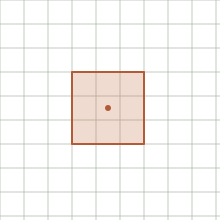
Planck length
The Planck length is a scale formed from fundamental physical constants.
1.616 × 10⁻³⁵ mLengthBeyond the eye
What are they, and what does the difference actually look like?
Two things. One honest scale.
Meet the pair
The Planck length is a scale formed from fundamental physical constants.
1.616 × 10⁻³⁵ mLength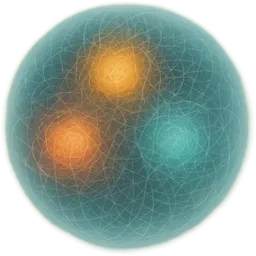
A proton is a positively charged particle found in the nucleus of atoms, made up of quarks.
1.682 fmDiameterThe diameter of Proton is about 1.04 × 10²⁰ times the length of Planck length.
A theoretical scale formed from the speed of light, reduced Planck constant and gravitational constant. It is not experimentally established as the smallest possible length. The area and volume are derived mathematical scales.
NIST — 2022 CODATA fundamental constants
The marked length is calibrated. Unmeasured illustration details are representative.
Twice the approximately 0.8409 fm charge radius. The charge distribution has no hard boundary; the illustration is schematic.
NIST — 2022 CODATA fundamental constants
The marked diameter is calibrated. Unmeasured illustration details are representative.
Change the comparison
Measurement details
The visual compares length with diameter. The records below preserve each value’s basis and caveats.
Length · theoretical
A theoretical scale formed from the speed of light, reduced Planck constant and gravitational constant. It is not experimentally established as the smallest possible length. The area and volume are derived mathematical scales.
Diameter · measured constant
Twice the approximately 0.8409 fm charge radius. The charge distribution has no hard boundary; the illustration is schematic.
The labelled spans and stored measurements determine the scale; unmeasured illustration details do not.
There’s always another scale
Fundamental physicsPlanck length1.616 × 10⁻³⁵ mThe Planck length is a scale formed from fundamental physical constants.Fundamental physicsProton1.682 fmA proton is a positively charged particle found in the nucleus of atoms, made up of quarks.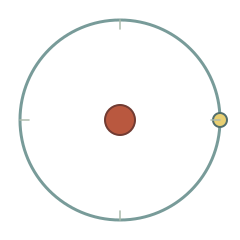 MicroscopicHydrogen atom105.8 pmA hydrogen atom is the simplest neutral atom, with one proton in its nucleus and one electron around it.
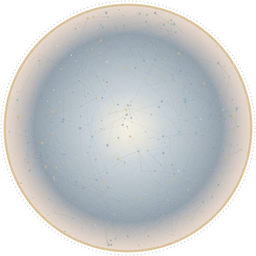 SpaceObservable universe28.21 GpcThe observable universe is the region from which light or other signals have had time to reach us since the early universe.Fundamental physicsPlanck mass21.76 µgThe Planck mass is a theoretical mass scale derived from fundamental constants, significant in discussions of quantum gravity.
 MicroscopicDNA double helix2 nmDNA is the molecule that stores hereditary information in living organisms.
Side by side