Planck length
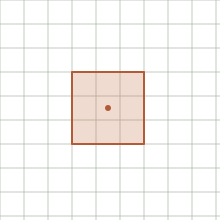
The Planck length is a scale formed from fundamental physical constants.
1.616 × 10⁻³⁵ mLengthWorlds apart
What are they, and what does the difference actually look like?
Two things. One honest scale.
Meet the pair
The Planck length is a scale formed from fundamental physical constants.
1.616 × 10⁻³⁵ mLength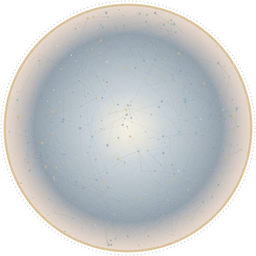
The observable universe is the region from which light or other signals have had time to reach us since the early universe.
28.21 GpcDiameterThe diameter of Observable universe is about 5.39 × 10⁶¹ times the length of Planck length.
A theoretical scale formed from the speed of light, reduced Planck constant and gravitational constant. It is not experimentally established as the smallest possible length. The area and volume are derived mathematical scales.
NIST — 2022 CODATA fundamental constants
The marked length is calibrated. Unmeasured illustration details are representative.
About 92 billion light-years across in present-day comoving distance. Space expanded while the light travelled. The 13.8-billion-year age is a time, not its radius divided by light speed. The total universe may be far larger, possibly infinite.
NASA — How big is space? (2025)
The marked diameter is calibrated. Unmeasured illustration details are representative.
Change the comparison
Measurement details
The visual compares length with diameter. The records below preserve each value’s basis and caveats.
Length · theoretical
A theoretical scale formed from the speed of light, reduced Planck constant and gravitational constant. It is not experimentally established as the smallest possible length. The area and volume are derived mathematical scales.
Diameter · cosmological estimate
About 92 billion light-years across in present-day comoving distance. Space expanded while the light travelled. The 13.8-billion-year age is a time, not its radius divided by light speed. The total universe may be far larger, possibly infinite.
The labelled spans and stored measurements determine the scale; unmeasured illustration details do not.
There’s always another scale
Fundamental physicsPlanck length1.616 × 10⁻³⁵ mThe Planck length is a scale formed from fundamental physical constants.SpaceObservable universe28.21 GpcThe observable universe is the region from which light or other signals have had time to reach us since the early universe.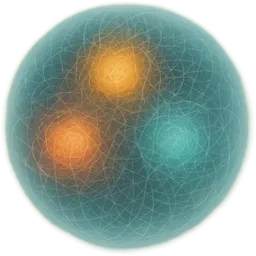 Fundamental physicsProton1.682 fmA proton is a positively charged particle found in the nucleus of atoms, made up of quarks.
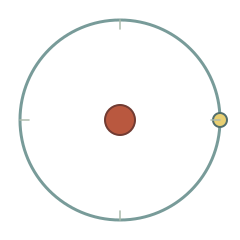 MicroscopicHydrogen atom105.8 pmA hydrogen atom is the simplest neutral atom, with one proton in its nucleus and one electron around it.Fundamental physicsPlanck mass21.76 µgThe Planck mass is a theoretical mass scale derived from fundamental constants, significant in discussions of quantum gravity.
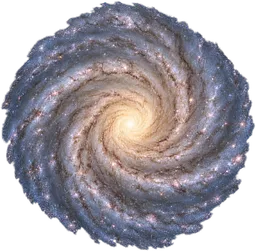 SpaceMilky Way30.66 kpcThe Milky Way is a spiral galaxy containing hundreds of billions of stars, including our Solar System.
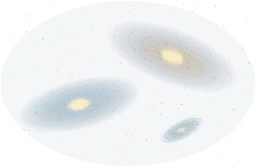 SpaceLocal Group3.066 MpcThe Local Group is a collection of galaxies that includes the Milky Way, Andromeda, and several smaller galaxies.
Side by side