LISA Pathfinder free-falling test mass
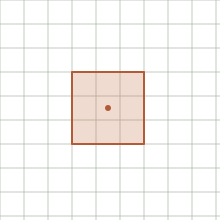
The LISA Pathfinder free-falling test mass is a precisely controlled object in space used to demonstrate technologies for detecting gravitational waves by minimising non-gravitational forces.
Also known as: LISA Pathfinder residual acceleration
How big is it?
5 × 10⁻¹⁵ N of force
Equivalent differential force on a 1 kg test mass · approximate performance anchor
Typical recorded range: 1 × 10⁻¹⁵ N to 3 × 10⁻¹⁴ N.
A little perspective
Single DNA molecule stretching force is about 10,000 times larger on this measurement.
Single DNA molecule stretching force: Single DNA molecule stretching force is the force required to extend a single DNA strand under controlled laboratory conditions.
Measurements, assumptions & sources +
LISA Pathfinder free-falling test mass
A representative LISA Pathfinder residual-acceleration scale expressed as the equivalent differential force on a defined 1 kg test mass near millihertz frequencies. Performance depends on frequency and analysis conditions.
ESA — LISA Pathfinder overview
The marked equivalent differential force on a 1 kg test mass is calibrated. Unmeasured illustration details are representative.
Single DNA molecule stretching force
A representative 50 pN single-molecule force in the DNA stretching regime. Measured force depends on construct, contour state, buffer, temperature and pulling protocol; the molecular image is schematic.
NIST — DNA stretching measurements
The marked representative stretching force is calibrated. Unmeasured illustration details are representative.
Change your perspective
Put it next to…
Choose a suggestion to redraw the comparison, or open its page to learn what it is.
Why this measurement?
Why we use 5 × 10⁻¹⁵ N
For comparison, this page uses equivalent differential force on a 1 kg test mass. This is labelled approximate performance anchor; the central value is useful for comparison, while real values or measurement solutions can vary. The recorded range is 1 × 10⁻¹⁵ N to 3 × 10⁻¹⁴ N.
A representative LISA Pathfinder residual-acceleration scale expressed as the equivalent differential force on a defined 1 kg test mass near millihertz frequencies. Performance depends on frequency and analysis conditions.
The identifying illustration and the numerical comparison remain separate. How calibrated comparisons work →
Recorded properties
LISA Pathfinder free-falling test mass dimensions and measurements
| Property | Selected value | Recorded range | Basis |
|---|---|---|---|
| 5 × 10⁻¹⁵ N | 1 × 10⁻¹⁵ N to 3 × 10⁻¹⁴ N | approximate performance anchor |
Around this scale
Go smaller. Go bigger.
These links use compatible weight records, ordered around the selected value.
Sources and method
Want to check the number?
The source records and measurement method remain available for inspection.
- ESA — LISA Pathfinder overviewMission overview for drag-free proof masses and precision metrology; acceleration performance depends on frequency.
There’s always another scale
Follow your curiosity.
Fundamental physicsPlanck length1.616 × 10⁻³⁵ mThe Planck length is a scale formed from fundamental physical constants. Fundamental physicsSingle DNA molecule stretching force5 × 10⁻¹¹ NSingle DNA molecule stretching force is the force required to extend a single DNA strand under controlled laboratory conditions.
 GravityGravitational attraction between two one-kilogram masses one metre apart6.7 × 10⁻¹¹ NThis is the gravitational force acting between two one-kilogram objects placed one metre apart in a vacuum.GravityEarth-Moon L1 tidal acceleration over one kilometre8.03 × 10⁻⁸ NEarth-Moon L1 tidal acceleration over one kilometre is the difference in gravitational pull experienced across a one-kilometre distance near the Earth-Moon L1 point.GravityGravitational attraction between two people one metre apart3 × 10⁻⁷ NThis is the gravitational force that two people exert on each other when separated by one metre.
 Fundamental physicsSnowflake aerodynamic drag1 × 10⁻⁶ NSnowflake aerodynamic drag is the resistive force experienced by a falling snowflake as it moves through air.Fundamental physicsPhoton pressure thrust per kilowatt6.7 × 10⁻⁶ NPhoton pressure thrust per kilowatt is the force generated when one kilowatt of light is absorbed or reflected, due to photon momentum.Fundamental physicsRadiation pressure on a laser mirror7 × 10⁻⁶ NRadiation pressure on a laser mirror is the force exerted by a laser beam as its photons strike and reflect from the mirror.