
Hydrogen atom ground-state binding energy
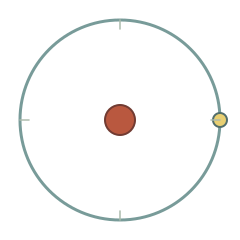
Hydrogen atom ground-state binding energy is the energy needed to remove the electron from a hydrogen atom in its lowest energy state.
Also known as: hydrogen ionisation energy, hydrogen ground state energy
How big is it?
13.61 eV · ground-state binding energy
Ground-state binding energy · recommended value
A little perspective
Hydrogen atom ground-state binding energy vs Green photon energy: energy comparison
The ground-state binding energy of a hydrogen atom is about 6.04 times the energy of a green photon.
ENERGY STORED OR TRANSFERRED
Hydrogen atom ground-state binding energy is the energy needed to remove the electron from a hydrogen atom in its lowest energy state.
Green photon energy is the energy carried by a single photon of green light, determined by its wavelength and fundamental physical constants.
Measurements, assumptions & sources +
Hydrogen atom ground-state binding energy
Ground-state binding energy: 13.61 eV; recommended value.
The magnitude of the hydrogen ground-state binding energy is approximately 13.598 eV, or 2.1799 × 10⁻¹⁸ J. It is the energy required to ionise ground-state hydrogen, not a classical stored-energy shell.
NIST — Atomic spectra database ionization energies
The marked ground-state binding energy is calibrated. Unmeasured illustration details are representative.
Green photon energy
Photon energy at 550 nm: 2.253 eV; derived from defined specimen; range 2.247 eV–2.259 eV.
A defined 550 nm photon carries about 3.61 × 10⁻¹⁹ J, calculated from exact c and h. Green light spans a range of wavelengths, so this is one explicit wavelength specimen.
NIST — 2022 CODATA fundamental constants
The marked photon energy at 550 nm is calibrated. Unmeasured illustration details are representative.
Use the visual comparison to explore its scale, then check the measurements and sources.
Change your perspective
Put it next to…
Choose a suggestion to redraw the comparison, or open its page to learn what it is.
Why this measurement?
Why we use 13.61 eV
We compare the ground-state binding energy of a hydrogen atom. This is an illustrative comparison value, not a claim that every example is the same.
The magnitude of the hydrogen ground-state binding energy is approximately 13.598 eV, or 2.1799 × 10⁻¹⁸ J. It is the energy required to ionise ground-state hydrogen, not a classical stored-energy shell.
The picture identifies the subject; the diagram compares the recorded values. How calibrated comparisons work →
Recorded properties
Dimensions and measurements
| Property | Selected value | Recorded range | Basis |
|---|---|---|---|
| 13.61 eV | Not recorded | recommended value |
Around this scale
Explore nearby values.
Compare examples with lower, similar and higher values. Each card names the measurement being compared.
 Nearest lower valueEnergyVisible photon2.247 eVEnergyA visible photon is a single particle of light within the range detectable by the human eye.Nearest higher valueEnergyDeuterium–tritium fusion reaction energy2.82 × 10⁻¹² JReleased energy per reactionDeuterium–tritium fusion reaction energy is the amount of energy released when a deuterium nucleus fuses with a tritium nucleus, producing a neutron and an alpha particle.
Sources and method
Want to check the number?
The source records and measurement method remain available for inspection.
- NIST — Atomic spectra database ionization energiesRecommended hydrogen ground-state ionization energy; joules are converted from electronvolts.
There’s always another scale
Follow your curiosity.
MicroscopicHydrogen atom105.8 pmA hydrogen atom is the simplest neutral atom, with one proton in its nucleus and one electron around it.EnergyVisible photon2.247 eVA visible photon is a single particle of light within the range detectable by the human eye.EnergyGreen photon energy2.253 eVGreen photon energy is the energy carried by a single photon of green light, determined by its wavelength and fundamental physical constants.Fundamental physicsStrontium-87 optical clock transition1.779 eVThe strontium-87 optical clock transition is an energy change between two quantum states of strontium atoms that can set the timing of an optical atomic clock.Fundamental physicsCaesium-133 clock transition108.8 psThe caesium-133 clock transition is the specific change in energy state of a caesium-133 atom that defines the duration of one second in the International System of Units.EnergyDeuterium–tritium fusion reaction energy2.82 × 10⁻¹² JDeuterium–tritium fusion reaction energy is the amount of energy released when a deuterium nucleus fuses with a tritium nucleus, producing a neutron and an alpha particle.Fundamental physicsHydrogen 21 cm hyperfine transition5.873 × 10⁻⁶ eVThis is a change in the energy state of neutral hydrogen atoms that produces or absorbs radio waves, widely used in radio astronomy.EnergyOne-gigaelectronvolt cosmic-ray proton1.602 × 10⁻¹⁰ JA one-gigaelectronvolt cosmic-ray proton is a hydrogen nucleus travelling through space with a kinetic energy of 1 GeV.