Eddington luminosity of a solar-mass object
The Eddington luminosity of a solar-mass object is the theoretical maximum brightness a star with the Sun's mass can achieve before radiation pressure overcomes gravity.
How big is it?
1.3 × 10¹⁹ TW of power
Power · specified

A little perspective
Crab pulsar spin-down power is about 3.54 times larger on this measurement.
Crab pulsar spin-down power: Crab pulsar spin-down power is the rate at which the Crab pulsar loses rotational energy, emitting it as radiation and particles.
Measurements, assumptions & sources +
Eddington luminosity of a solar-mass object
A curated eddington luminosity of a solar-mass object comparison anchor. The representative value and any stated range preserve the backlog measurement convention; operating or experimental conditions can change real observations.
Defined examples — our methodology
The marked power is calibrated. Unmeasured illustration details are representative.
Crab pulsar spin-down power
A curated crab pulsar spin-down power comparison anchor. The representative value and any stated range preserve the backlog measurement convention; operating or experimental conditions can change real observations.
Defined examples — our methodology
The marked power is calibrated. Unmeasured illustration details are representative.
Change your perspective
Put it next to…
Choose a suggestion to redraw the comparison, or open its page to learn what it is.
Why this measurement?
Why we use 1.3 × 10¹⁹ TW
For comparison, this page uses power. The record labels this value specified, so the stated convention rather than an inferred average controls the comparison.
A curated eddington luminosity of a solar-mass object comparison anchor. The representative value and any stated range preserve the backlog measurement convention; operating or experimental conditions can change real observations.
The identifying illustration and the numerical comparison remain separate. How calibrated comparisons work →
Recorded properties
Eddington luminosity of a solar-mass object dimensions and measurements
| Property | Selected value | Recorded range | Basis |
|---|---|---|---|
| 1.3 × 10¹⁹ TW | Not recorded | specified |
Around this scale
Go smaller. Go bigger.
These links use compatible power records, ordered around the selected value.
Sources and method
Want to check the number?
The source records and measurement method remain available for inspection.
There’s always another scale
Follow your curiosity.
PowerCrab pulsar spin-down power4.6 × 10¹⁹ TWCrab pulsar spin-down power is the rate at which the Crab pulsar loses rotational energy, emitting it as radiation and particles.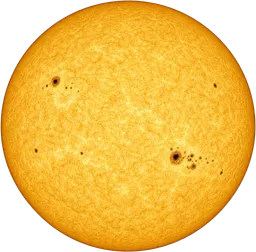 SpaceSun1,391,000 kmThe Sun is the star at the centre of the Solar System.
 PowerAndromeda galaxy stellar luminosity1 × 10²⁵ TWAndromeda galaxy stellar luminosity is the total power emitted as starlight by all the stars in the Andromeda galaxy.
 PowerLarge grid demand40 GWThe total electrical power required by all users connected to a large electricity grid at a given moment.
 PowerSaturn V liftoff propulsive power190 GWSaturn V liftoff propulsive power is the rate at which the Saturn V rocket’s engines converted fuel energy into thrust during launch.
 PowerThree Gorges Dam rated output22.5 GWThree Gorges Dam rated output is the maximum electrical power the dam's generators are designed to produce.PowerItaipu Dam rated output14 GWItaipu Dam rated output is the maximum electrical power the Itaipu hydroelectric dam is designed to generate under standard conditions.
 PowerSpace Shuttle main engine thermal power12 GWSpace Shuttle main engine thermal power is the rate at which heat energy is produced by the engine's combustion during operation.