
Brain coral colony
A brain coral colony is a living mound-shaped formation of coral polyps that secrete a grooved, dome-like calcium carbonate skeleton.
Also known as: massive brain coral, brain coral head
How big is it?
1.5 m · defined colony diameter
Also 4.921 ft
Defined colony diameter · defined specimen
Typical recorded range: 60 cm to 2 m.
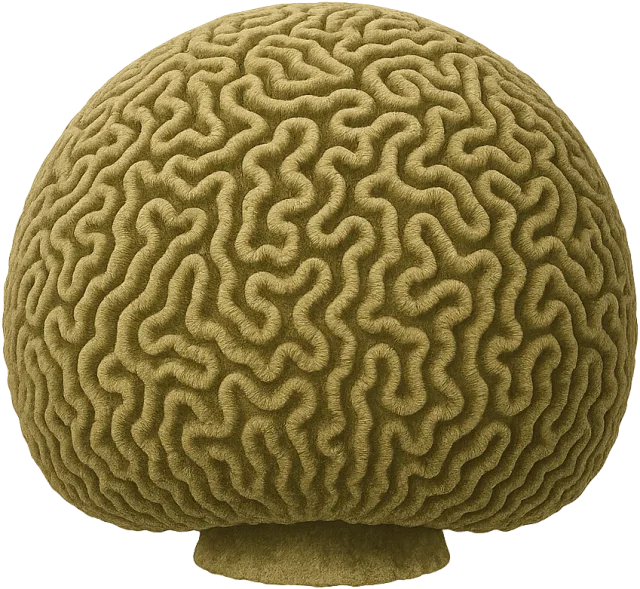
A little perspective
Brain coral colony vs Gorgonian sea fan: length comparison
The colony diameter of a brain coral colony is approximately equal to the colony height of a gorgonian sea fan.
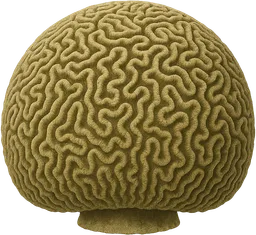
A brain coral colony is a living mound-shaped formation of coral polyps that secrete a grooved, dome-like calcium carbonate skeleton.
A gorgonian sea fan is a colony of small coral-like animals supported by a branching, fan-shaped skeleton.
Both rulers start at the same zero and share one linear scale. Artwork keeps its original proportions. Horizontal rulers compare the selected spans; vertical brackets also identify height on the artwork.
Measurements, assumptions & sources +
Brain coral colony
Defined colony diameter: 1.5 m; defined specimen; range 60 cm–2 m.
A defined massive brain-coral colony 1.5 m across with a 900 kg wet skeletal mass. Species, growth form and cavities vary; the living grooved dome, not attached reef rock, defines the diameter.
Smithsonian Ocean — Corals and coral reefs
The marked defined colony diameter is calibrated. Unmeasured illustration details are representative.
Gorgonian sea fan
Defined colony height: 1.5 m; defined specimen; range 50 cm–2 m.
A defined mature gorgonian sea-fan colony 1.5 m high and 1.2 m wide. Species, current exposure and breakage produce highly variable branching forms; the holdfast is included and attached reef rock is excluded.
Smithsonian Ocean — Corals and coral reefs
The marked defined colony height is calibrated. Unmeasured illustration details are representative.
Use the visual comparison to explore its scale, then check the measurements and sources.
Change your perspective
Put it next to…
Choose a suggestion to redraw the comparison, or open its page to learn what it is.
Why this measurement?
Why we use 1.5 m
We compare the colony diameter of a brain coral colony. This is an illustrative comparison value, not a claim that every example is the same. The recorded range is 60 cm to 2 m.
A defined massive brain-coral colony 1.5 m across with a 900 kg wet skeletal mass. Species, growth form and cavities vary; the living grooved dome, not attached reef rock, defines the diameter.
The marked horizontal span follows the measured feature, not the edges of the image. How calibrated comparisons work →
Recorded properties
Dimensions and measurements
| Property | Selected value | Recorded range | Basis |
|---|---|---|---|
| 1.5 m | 60 cm to 2 m | defined specimen | |
| 900 kg | 200 kg to 1.8 t | defined specimen |
Around this scale
Explore nearby values.
Compare examples with lower, similar and higher values. Each card names the measurement being compared.
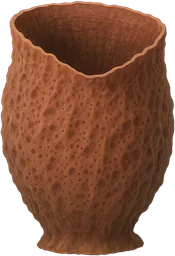 Nearest lower valueLiving thingsGiant barrel sponge1.2 mDefined colony heightA giant barrel sponge is a large, hollow marine animal that filters food particles from seawater through its porous body.
 Around the same scaleLiving thingsGorgonian sea fan1.5 mDefined colony heightA gorgonian sea fan is a colony of small coral-like animals supported by a branching, fan-shaped skeleton.
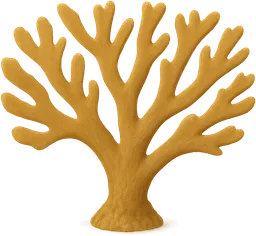 Nearest higher valueLiving thingsElkhorn coral colony2 mDefined colony widthAn elkhorn coral colony is a branching formation of the coral species Acropora palmata, found in shallow Caribbean reefs.
Sources and method
Want to check the number?
The source records and measurement method remain available for inspection.
- Smithsonian Ocean — Corals and coral reefsMassive coral colony anatomy and growth; the atlas uses a defined grooved dome specimen.
There’s always another scale
Follow your curiosity.
Living thingsElkhorn coral colony2 mAn elkhorn coral colony is a branching formation of the coral species Acropora palmata, found in shallow Caribbean reefs.Living thingsGiant barrel sponge1.2 mA giant barrel sponge is a large, hollow marine animal that filters food particles from seawater through its porous body.Living thingsGorgonian sea fan1.5 mA gorgonian sea fan is a colony of small coral-like animals supported by a branching, fan-shaped skeleton. SportArchery target boss1.3 mAn archery target boss is a round, thick backing made to safely stop arrows during target shooting.
 PeopleAdult in firefighting gear1.78 mAn adult in firefighting gear is a person wearing protective clothing and breathing apparatus for structural firefighting.
 ContainersOak wine tun1 m³An oak wine tun is a large wooden vessel traditionally used for fermenting or storing wine.
 Everyday thingsBall gown1.5 mA ball gown is a formal evening dress with a fitted bodice and a full skirt, traditionally worn at balls and other ceremonial occasions.
 SpaceExplorer 12.03 mExplorer 1 was the first satellite launched by the United States, carrying scientific instruments to study Earth's radiation environment.