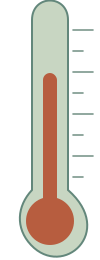

-100 degrees Celsius
-100 °CTemperature · definition
Celsius and Fahrenheit have shifted zero points. Differences are useful; “twice as hot” in °C or °F is not a physical temperature ratio.

Temperature
Below freezing
Celsius and Fahrenheit have shifted zero points.
The dry ice sublimation point is the temperature at which solid carbon dioxide turns directly into gas at standard atmospheric pressure.
A little perspective
-100 degrees Celsius is 21.5 K lower than the dry ice sublimation point.
Temperature: -100 °C; definition.
Celsius and Fahrenheit have shifted zero points. Differences are useful; “twice as hot” in °C or °F is not a physical temperature ratio.
Sublimation temperature at one atmosphere: -78.5 °C; approximate.
Solid carbon dioxide sublimates near 194.65 K (−78.5 °C) at one atmosphere rather than melting. Pressure changes the phase boundary.
NIST Chemistry WebBook — Carbon dioxide
The marked sublimation temperature at one atmosphere is calibrated. Unmeasured illustration details are representative.
Measurement details
Compare -100 degrees Celsius with the dry ice sublimation point. The notes below explain how each value was chosen.
Temperature · definition
Celsius and Fahrenheit have shifted zero points. Differences are useful; “twice as hot” in °C or °F is not a physical temperature ratio.
Sublimation temperature at one atmosphere · approximate
Solid carbon dioxide sublimates near 194.65 K (−78.5 °C) at one atmosphere rather than melting. Pressure changes the phase boundary.
The diagram uses the recorded measurements. Details outside the marked spans do not set the scale.
Compare temperature differences in kelvins; Celsius and Fahrenheit ratios are not meaningful.
Change your perspective
Choose a suggestion to redraw the comparison, or open its page to learn what it is.
A little smaller. A little larger.