
13.8 billion years
13.8 GyrTime · definition
Time conversions use a Julian year of exactly 365.25 days.

Time
A duration of 13.8 billion years is 4.354949 × 10¹⁷ seconds.
Deep time
ELAPSED TIME
Time conversions use a Julian year of exactly 365.25 days.
The observable universe is the region from which light or other signals have had time to reach us since the early universe.
A little perspective
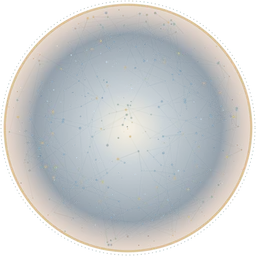
13.8 billion years is approximately equal to the age of the observable universe.
Time: 13.8 Gyr; definition.
Time conversions use a Julian year of exactly 365.25 days.
Age: 13.8 Gyr; cosmological estimate.
About 92 billion light-years across in present-day comoving distance. Space expanded while the light travelled. The 13.8-billion-year age is a time, not its radius divided by light speed. The total universe may be far larger, possibly infinite.
The marked age is calibrated. Unmeasured illustration details are representative.
Measurement details
Compare 13.8 billion years with the age of the observable universe. The notes below explain how each value was chosen.
Time · definition
Time conversions use a Julian year of exactly 365.25 days.
Age · cosmological estimate
About 92 billion light-years across in present-day comoving distance. Space expanded while the light travelled. The 13.8-billion-year age is a time, not its radius divided by light speed. The total universe may be far larger, possibly infinite.
The diagram uses the recorded measurements. Details outside the marked spans do not set the scale.
A duration is an interval, not a calendar date.
Change your perspective
Choose a suggestion to redraw the comparison, or open its page to learn what it is.
A little smaller. A little larger.