
Influenza virion
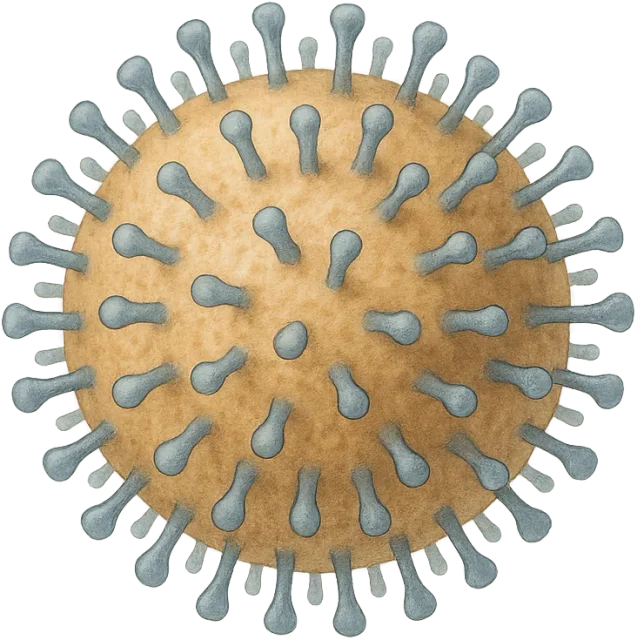
An influenza virion is a single infectious particle of the influenza virus, consisting of genetic material inside a lipid envelope.
Also known as: influenza virus particle, flu virion
How big is it?
100 nm · representative envelope diameter
Representative envelope diameter · representative
Typical recorded range: 80 nm to 120 nm.
A little perspective
Influenza virion vs Virus: length comparison
The envelope diameter of an influenza virion is approximately equal to the characteristic size of a virus.
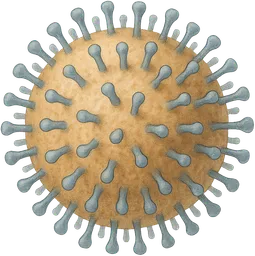
An influenza virion is a single infectious particle of the influenza virus, consisting of genetic material inside a lipid envelope.
A virus is an infectious particle containing genetic material inside a protein coat, sometimes with an outer envelope.
Both rulers start at the same zero and share one linear scale. Artwork keeps its original proportions.
Measurements, assumptions & sources +
Influenza virion
Representative envelope diameter: 100 nm; representative; range 80 nm–120 nm.
A representative 100 nm enveloped influenza particle. Shape and size vary, and surface proteins extend beyond the selected envelope diameter.
The marked representative envelope diameter is calibrated. Unmeasured illustration details are representative.
Virus
Characteristic size: 100 nm; representative.
A chosen 100 nm viral particle, including the approximate envelope. Viruses vary greatly.
University of Utah — Cell size and scale
The marked characteristic size is calibrated. Unmeasured illustration details are representative.
Use the visual comparison to explore its scale, then check the measurements and sources.
Change your perspective
Put it next to…
Choose a suggestion to redraw the comparison, or open its page to learn what it is.
Why this measurement?
Why we use 100 nm
We compare the envelope diameter of an influenza virion. This is a representative comparison value; individual specimens or conditions can vary. The recorded range is 80 nm to 120 nm.
A representative 100 nm enveloped influenza particle. Shape and size vary, and surface proteins extend beyond the selected envelope diameter.
The marked horizontal span follows the measured feature, not the edges of the image. How calibrated comparisons work →
Recorded properties
Dimensions and measurements
| Property | Selected value | Recorded range | Basis |
|---|---|---|---|
| 100 nm | 80 nm to 120 nm | representative |
Around this scale
Explore nearby values.
Compare examples with lower, similar and higher values. Each card names the measurement being compared.
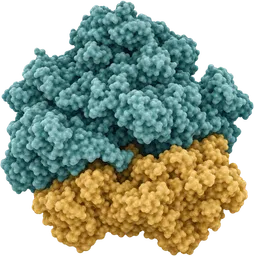 Nearest lower valueMicroscopic objectsRibosome25 nmCharacteristic sizeA ribosome is a molecular machine that builds proteins by reading instructions carried by messenger RNA.
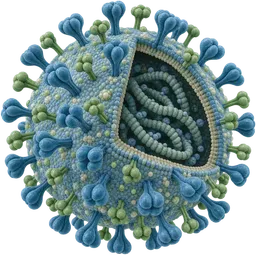 Around the same scaleMicroscopic objectsVirus100 nmCharacteristic sizeA virus is an infectious particle containing genetic material inside a protein coat, sometimes with an outer envelope.
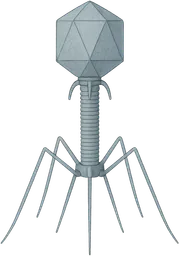 Nearest higher valueMicroscopic objectsBacteriophage T4200 nmHead-to-tail lengthBacteriophage T4 is a virus that infects bacteria.
Sources and method
Want to check the number?
The source records and measurement method remain available for inspection.
- CDC — Influenza virusesInfluenza virions are enveloped particles with variable morphology; 100 nm is a representative diameter.
There’s always another scale
Follow your curiosity.
MicroscopicVirus100 nmA virus is an infectious particle containing genetic material inside a protein coat, sometimes with an outer envelope.MicroscopicBacteriophage T4200 nmBacteriophage T4 is a virus that infects bacteria.MicroscopicRibosome25 nmA ribosome is a molecular machine that builds proteins by reading instructions carried by messenger RNA.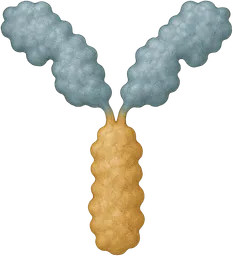 MicroscopicIgG antibody molecule14.5 nmAn IgG antibody molecule is a Y-shaped protein produced by the immune system to identify and neutralise foreign substances.
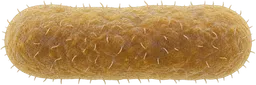 MicroscopicBacterium2 µmA bacterium is a single-celled microorganism without a membrane-bound nucleus.
 MicroscopicPlatelet3 µmA platelet is a small blood-cell fragment that helps form clots and stop bleeding after a blood vessel is damaged.
 MicroscopicDNA double helix2 nmDNA is the molecule that stores hereditary information in living organisms.
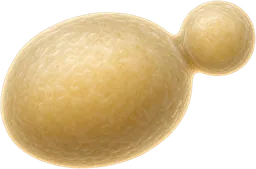 MicroscopicYeast cell5 µmYeast is a group of single-celled fungi.