
1 Planck volume
4.222 × 10⁻¹⁰² LVolume · definition
A theoretical scale made from physical constants. It is not a proven smallest object or a hard physical limit.

Volume & capacity
Microscopic
A theoretical scale made from physical constants.
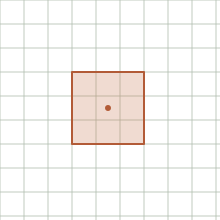
Too small to see at this scale. The ring marks its true-scale position, not its volume. The shape has not been enlarged.
The Planck length is a scale formed from fundamental physical constants.
Too small to see at this scale. The ring marks its true-scale position, not its volume. The shape has not been enlarged.
A little perspective
1 Planck volume is approximately equal to the volume of the Planck length.
Volume: 4.222 × 10⁻¹⁰² L; definition.
A theoretical scale made from physical constants. It is not a proven smallest object or a hard physical limit.
Volume: 4.222 × 10⁻¹⁰² L; theoretical.
A theoretical scale formed from the speed of light, reduced Planck constant and gravitational constant. It is not experimentally established as the smallest possible length. The area and volume are derived mathematical scales.
NIST — 2022 CODATA fundamental constants
The marked volume is calibrated. Unmeasured illustration details are representative.
Measurement details
Compare 1 Planck volume with the volume of the Planck length. The notes below explain how each value was chosen.
Volume · definition
A theoretical scale made from physical constants. It is not a proven smallest object or a hard physical limit.
Volume · theoretical
A theoretical scale formed from the speed of light, reduced Planck constant and gravitational constant. It is not experimentally established as the smallest possible length. The area and volume are derived mathematical scales.
The diagram uses the recorded measurements. Details outside the marked spans do not set the scale.
Volume measures three-dimensional space; a container’s capacity is not its outside dimensions.
Change your perspective
Choose a suggestion to redraw the comparison, or open its page to learn what it is.
A little smaller. A little larger.