
Absolute zero
Absolute zero is the lowest temperature permitted by thermodynamics, where a system has the least thermal energy available to it.
How big is it?
0 K · temperature
Also -459.7 °F
Temperature · approximate

A little perspective
Absolute zero vs Superfluid helium lambda point: temperature comparison
Absolute zero is 2.17 K lower than the superfluid helium lambda point.
Absolute zero is the lowest temperature permitted by thermodynamics, where a system has the least thermal energy available to it.
The superfluid helium lambda point is the temperature at which helium-4 transitions from a normal liquid to a superfluid state.
Measurements, assumptions & sources +
Absolute zero
Temperature: 0 K; approximate.
The zero of the thermodynamic kelvin scale. It is approached in experiments, not reached by ordinary finite cooling.
NIST — 2022 CODATA fundamental constants
The marked temperature is calibrated. Unmeasured illustration details are representative.
Superfluid helium lambda point
Temperature: 2.17 K; measured approximate.
The 2.17 K value is a rounded helium-4 lambda transition reference near saturated vapour pressure, not a pressure-independent constant.
Rounded helium-4 lambda-transition temperature at saturated vapour pressure; the transition temperature varies with pressure.
NIST Technical Note 1334 — Thermodynamic Properties of Helium-4
The marked temperature is calibrated. Unmeasured illustration details are representative.
Use the visual comparison to explore its scale, then check the measurements and sources.
Change your perspective
Put it next to…
Choose a suggestion to redraw the comparison, or open its page to learn what it is.
Why this measurement?
Why we use 0 K
We compare absolute zero. This is an estimate; check the notes for its rounding and uncertainty.
The zero of the thermodynamic kelvin scale. It is approached in experiments, not reached by ordinary finite cooling.
The picture identifies the subject; the diagram compares the recorded values. How calibrated comparisons work →
Recorded properties
Dimensions and measurements
| Property | Selected value | Recorded range | Basis |
|---|---|---|---|
| 0 K | Not recorded | approximate |
Around this scale
Explore nearby values.
Compare examples with lower, similar and higher values. Each card names the measurement being compared.
 Around the same scaleTemperatureSuperfluid helium lambda point2.17 KTemperatureThe superfluid helium lambda point is the temperature at which helium-4 transitions from a normal liquid to a superfluid state.Nearest higher valueTemperatureUltracold atom cloud1 × 10⁻⁷ KTemperatureAn ultracold atom cloud is a collection of atoms cooled to temperatures near absolute zero, used in advanced physics experiments.
Sources and method
Want to check the number?
The source records and measurement method remain available for inspection.
- NIST — 2022 CODATA fundamental constantsRecommended constants with uncertainties; exact SI definitions are distinguished from measured constants.
More ways to see it
Curated comparisons
There’s always another scale
Follow your curiosity.
TemperatureRoom temperature20 °CRoom temperature describes indoor air conditions generally considered comfortable for people and suitable for ordinary activities.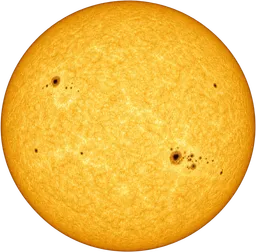 SpaceSun1,391,000 kmThe Sun is the star at the centre of the Solar System.
 Fundamental physicsPlanck temperature1.417 × 10³² KThe Planck temperature is a theoretical temperature scale at which quantum gravitational effects are expected to become important.TemperatureSuperfluid helium lambda point2.17 KThe superfluid helium lambda point is the temperature at which helium-4 transitions from a normal liquid to a superfluid state.
 TemperatureCosmic microwave background2.725 KThe cosmic microwave background is faint thermal radiation filling the universe, left over from the early stages after the Big Bang.TemperatureBoiling helium4.22 KBoiling helium is helium in its liquid state at its normal boiling point under standard atmospheric pressure.TemperatureUltracold atom cloud1 × 10⁻⁷ KAn ultracold atom cloud is a collection of atoms cooled to temperatures near absolute zero, used in advanced physics experiments.TemperatureHydrogen normal boiling point20.27 KHydrogen normal boiling point is the temperature at which hydrogen changes from a liquid to a gas at standard atmospheric pressure.