Story
The invisible world beneath a bee
A bee beside a pound coin is small. A bee beside a bacterium is enormous.
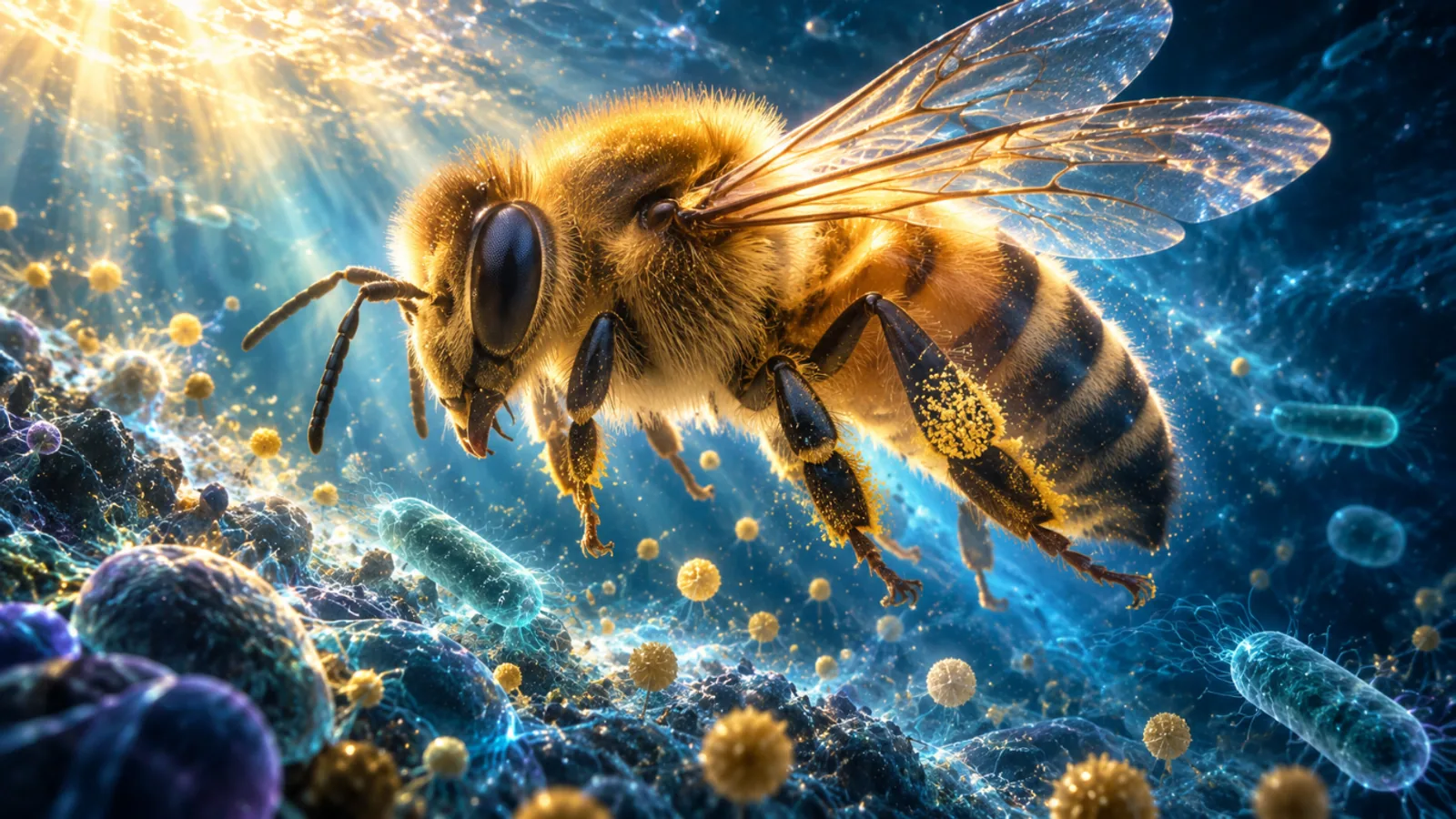
A bee beside a pound coin is small. A bee beside a bacterium is enormous.
Watch a worker honeybee land on a flower and you can still make sense of its size. You can see the legs, the wings, the body and perhaps a dusting of pollen. It is small enough to sit on a fingertip without becoming an abstract idea.
That makes it a useful place to start shrinking.
The worker honeybee used in these comparisons is 15 millimetres long, measured along the body and excluding its legs, wings and antennae. A current British £1 coin is 23.43 millimetres across at its widest point. The bee's body is comfortably shorter. [1, 2]
A 15 mm worker bee body beside a £1 coin measuring 23.43 mm point to point. The bee measurement excludes wings, legs and antennae.
Nothing about that comparison feels especially strange. The coin is familiar; the bee is familiar. Keep going, though, and the bee stops being the small thing in the picture.
Pollen is not really dust
A smear of yellow pollen can look almost textureless to the naked eye. Under magnification, it breaks into individual grains whose shapes and sizes vary between plant species.
The illustrative pollen grain below is 30 micrometres across. One micrometre, written µm, is one thousandth of a millimetre, so the grain is 0.03 millimetres wide. [3]
Put it beside the thickness of a human hair. The example hair is 70 micrometres across, a little more than twice the width of the grain. We are comparing the hair's thickness here, not its length; a strand of hair could run far beyond the frame. [3]
A 30 µm pollen grain beside the 70 µm thickness of an example human hair. Both measurements vary in the real world.
Now enlarge the picture until that 30-micrometre grain is one centimetre across. At exactly the same scale, the 15-millimetre bee would be five metres long.
The bee has not changed relative to the pollen. We have simply made the smaller thing large enough to handle, and discovered what that does to everything above it.
Beside a bacterium, the bee becomes a landmark
Go down another step. The bacterium in the next comparison is an illustrative two micrometres long. The bee's 15 millimetres is 15,000 micrometres, making its body 7,500 times longer. [4]
On one true linear scale, the bacterium is barely there. That is not a failure of the comparison. It is the comparison.
The bee's 15 mm body is 7,500 times the length of this illustrative 2 µm bacterium. The smaller object needs a labelled magnified inset to be inspectable.
Give the bacterium a more manageable size: two centimetres long. Keep the ratio fixed and the bee becomes 150 metres from end to end. Its body would run past the finish line of a 100-metre track and keep going for another half-track.
That is what 7,500 to one looks like when the smaller object is finally allowed to be visible.
And bacteria are not the bottom of the journey
The virus particle used below measures 100 nanometres across. A nanometre is one millionth of a millimetre, so 100 nanometres is 0.1 micrometres. Our two-micrometre bacterium is twenty times longer than the virus particle is wide. [5]
A 100 nm illustrative virus particle beside a 2 µm illustrative bacterium. Neither size is universal for its group.
If the bacterium were stretched to the length of a two-metre sofa, the virus particle would be about ten centimetres across. Oddly, that gap is easier to picture than the jump from bee to bacterium.
This is the problem with calling things simply "microscopic". The word sweeps together an enormous range of sizes. In our chosen examples, the pollen grain is fifteen times the bacterium's length and 300 times the virus particle's width. Those are linear comparisons; they do not tell you how many smaller objects would fit inside a larger one, which would depend on shape and volume as well.
Go back to the bee beside the pound coin. It is still the same 15-millimetre insect. It just no longer looks particularly small.
Sources and measurements
- JHB: worker honeybee and £1 coin comparison
- The Royal Mint: £1 coin specifications
- JHB: pollen-grain and human-hair examples
- JHB: honeybee and illustrative bacterium
- JHB: illustrative virus particle and bacterium
Ratios and imagined enlargements are calculated from the stated measurements. Sources checked 7 October 2026.