Story
The true size of a blue whale
Two buses, fourteen human heights and an orca that suddenly looks small.
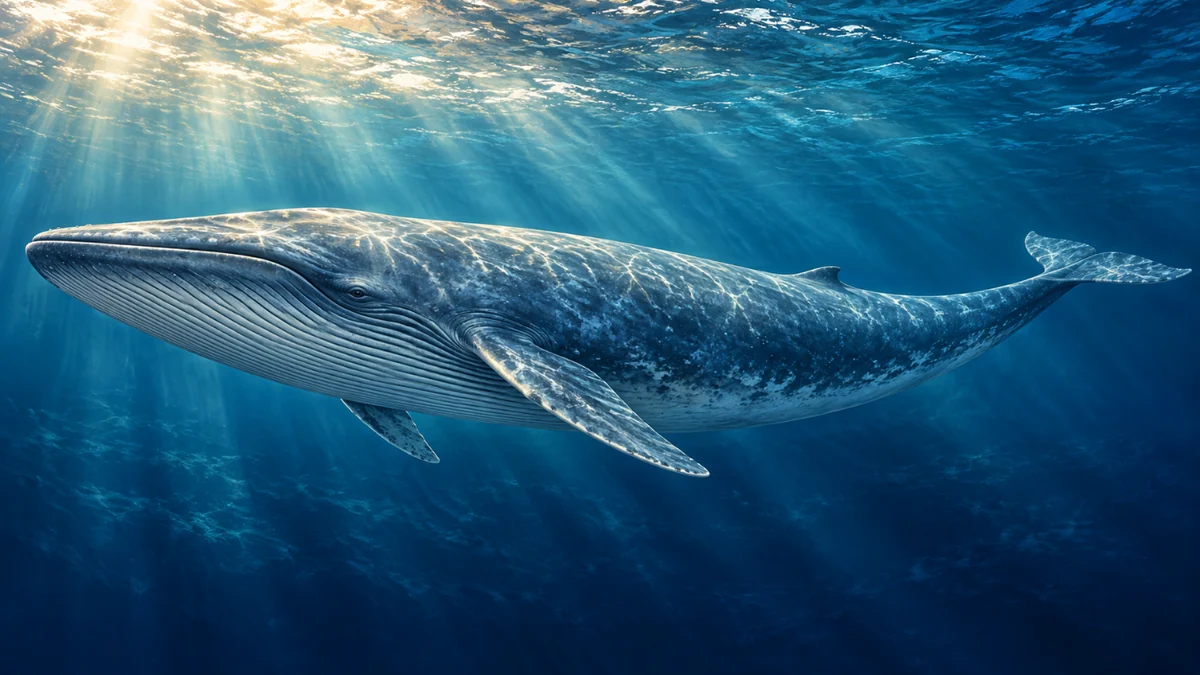
Picture two double-decker buses waiting nose to tail. Walk past the first, then the second. Keep going for another three metres.
You have just walked the length of the blue whale in the comparison below.
At 25 metres, this is a large adult chosen for the illustration, rather than a record-breaking specimen. The buses are 11 metres each. Put them beside the whale and a measurement that sounds fairly ordinary on paper starts taking up an unreasonable amount of street. [1]
Two 11-metre buses total 22 metres. This whale is 25 metres from nose to tail.
A whale is surprisingly difficult to picture
An ocean photograph gives us very little help. There may be a fin, a patch of back and water stretching to the horizon. Even a clear underwater image can lack anything familiar beside the animal. We recognise the shape without really knowing how much space it occupies.
Try adding a person.
The adult below stands 1.75 metres tall. The whale’s length is just over fourteen times that height. Imagine fourteen people lying in a straight line, head to foot: together they would reach 24.5 metres. There would still be half a metre left over. [2]
A 1.75-metre person’s height compared with a 25-metre whale’s length. The measurements run in different directions on the bodies.
Look at the person again after looking at the whale. That tiny figure is someone who could take up most of a doorway.
The comparison also explains why a whale can disappear into the sea so easily in a photograph. Once the frame is wide enough to contain the entire animal and some surrounding water, anything human-sized becomes a small detail.
Even an orca looks smaller beside it
An orca is already a substantial animal. The one here measures seven metres long, which would be an awkward thing to find occupying a swimming lane.
Beside the 25-metre blue whale, it reaches only a little over a quarter of the whale’s length. You would need three and a half of these orca lengths, plus a little extra, to match it. [3]
The selected blue whale is about 3.6 times the length of the selected orca. Real individuals vary.
This is where the comparison becomes especially useful. A bus gives us a familiar object. A person puts us in the scene. Another large whale shows just how far along the size scale a blue whale sits.
Length is only part of the animal
The blue whale used here also has a chosen mass of 100 tonnes. The human example is 70 kilograms. Switch the human comparison to Mass and the ratio becomes roughly 1,400 to one. [2]
That difference is much greater than the fourteen-to-one comparison of length with height. A body occupies space in three dimensions, and these two bodies have very different proportions. You cannot take a length ratio and use it as a weight ratio.
Nor does every blue whale match this one. Age, sex and population affect size. NOAA describes Antarctic blue whales reaching around 110 feet, or 33.5 metres. Our 25-metre example leaves plenty of room for larger individuals. [4]
All that body, fed by tiny prey
Perhaps the oddest thing about this enormous animal is its dinner. Blue whales eat mainly krill: small, shrimp-like crustaceans. A feeding whale takes in water and prey, then pushes the water out through baleen plates that retain the food. [4]
A whale-sized meal is assembled from huge numbers of small animals.
Next time two buses pull up together, follow their length with your eyes. Add another three metres beyond the second bus. Then imagine that entire distance moving past you with a slow stroke of its tail.
Sources and measurements
- JHB: bus and blue whale measurements
- JHB: human and blue whale measurements, including mass
- JHB: orca and blue whale measurements
- NOAA Fisheries: blue whale size, variation and feeding
Ratios and imagined enlargements are calculated from the stated measurements. Sources checked 7 October 2026.